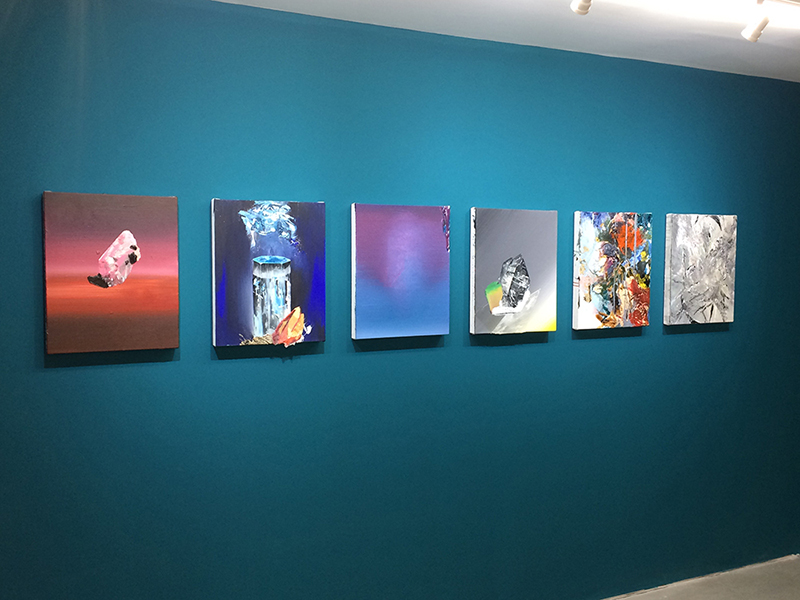
“I’m interested in the relationship between the abstract and the figurative. The challenge is to the viewer. I aim to challenge their perspective of reality and see how far my work will take them.” – Willian Santos in discussion with Contemporary Art Projects.
CAP. Could you tell us a bit about yourself and your background. Where did you study?
Willian Santos. I was born in 1985 in the city of Curitiba which is in the south of Brazil. I graduated in 2009 as a Bachelor of Visual Arts. I have been making art since the age of fourteen. I studied with the artist, Carla Vendrami who gave me my first lessons in painting. I then studied at the Federal University of Paraná with the artist Geraldo Leão. These experiences provided rich information which still informs my work today.
CAP. What is the arts scene like in Brazil?
WS. There is a strong art scene in Brazil and there are artists I really admire. The art scene in Curitiba is made up of really committed artists. Funding and studio space may be precarious but artists are never the less dedicated to their practice and advancing contemporary art. The picture differs in other regions of Brazil. I am concerned by the relationship between art fairs and galleries. Many critics, artists and curators seem to be consumed by the commercial relationship between the art fair and gallery rather than the art. This seems to be a similar situation around the world.

CAP. There is an exciting energy in your artworks, as though they are caught between a state of forming and decaying or becoming. Is this reflective of where you are as an artist at the moment?
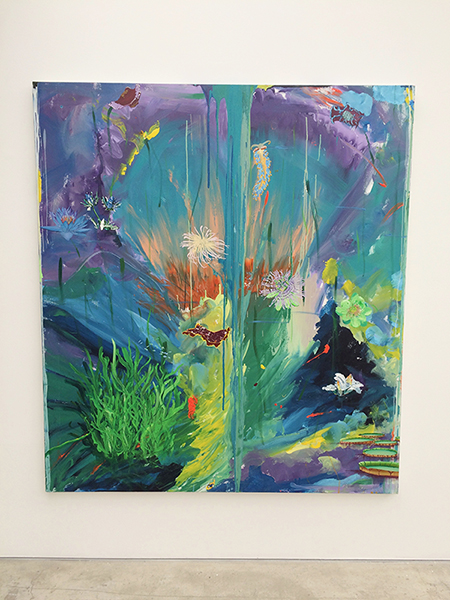
WS. This is an important theme in my work and practice. I am very interested in creating a sense of movement in my paintings. I also like to leave a trace of the process in my work. I am exploring the language of painting as a way to engage the viewer. I think the relationship between intention and the process of making creates an exciting tension or suspense in the viewer which is something I’m trying to capture. I am a young artist so the movement in my work may also be reflective of my context and place.
CAP. What are your main artistic influences? Are there any particular artists you’re inspired by?
WS. During the beginning of my career I studied several artists and their methods as a way to inform my own practice. I often incorporated other artist’s styles in my early work as a way of learning and developing my own style. I am also influenced by experimenting and working in the studio. But I really admire the work of Jasper Johns, Matisse, Caspar Friederich, Philip Guston, Rodin, Edward Hopper and Anselm Kiefer.
CAP. You’ve said that you use a “process of self-provocation with intent of creating different work methods, avoiding a style or a repetitive procedure”. Can you tell us a bit more about your technique? Do you start with an idea in mind or does meaning come through during the process of making?
WS. The idea of finding a set method for work is something that terrifies me. What excites me in each new job is to find new challenges. I need fresh provocation and inspiration to start a project. I like to work with the ideas that are already in my mind but I also experiment and find new possibilities.
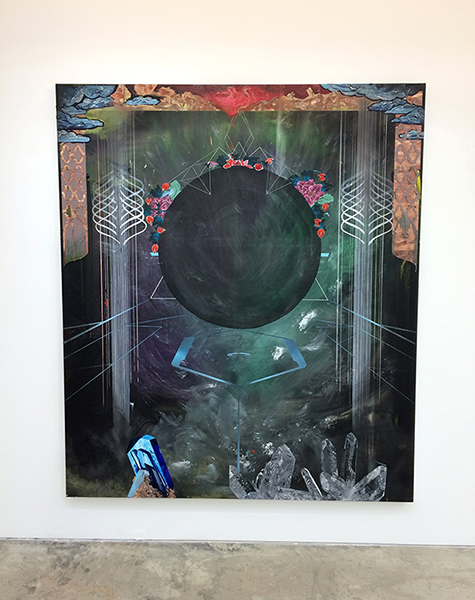
CAP. You’ve mentioned that your artworks “allow the audience to simultaneously go beyond and fall short of the image, a state of suspension.” What are the challenges in producing artwork that walks this tightrope?
WS. I think of this suspension as a hesitation. I’m interested in the relationship between the abstract and the figurative. The challenge is to the viewer. I aim to challenge their perspective of reality and see how far my work will take them. It’s very challenging to know where the viewer sits in this interplay.

CAP. What have you got planned next?
WS. I plan to develop my practice, with new research and new work. I have also been searching for residencies outside of Brazil.
Visit Willian’s website here; https://www.williansantos.com/
Read more interviews; https://contemporaryartprojects.art.blog/category/interviews/
 contemporaryartprojects.art.blog