
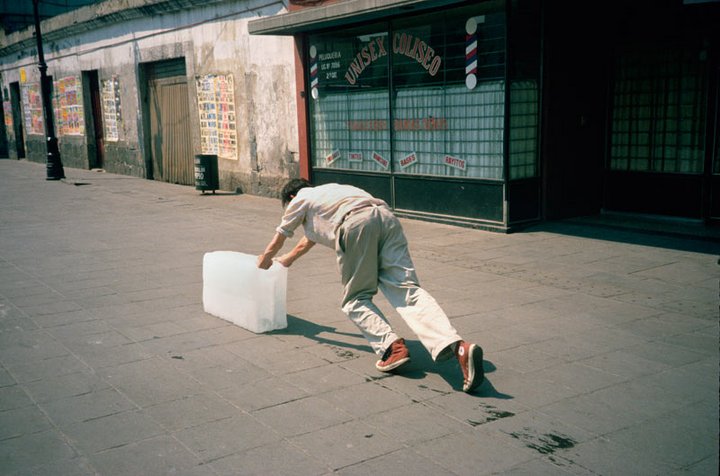
Pushing a large block of ice around a city until it melts may seem like a punishment from Greek mythology but this is exactly what artist Francis Alÿs did for his work ‘Paradox of Praxis 1 (Sometimes making something leads to nothing)” from 1997.
We start this epic journey by following Alÿs as he pushes a large block of ice down a street in Mexico City. The drips and drabs of melted ice water start to accumulate into small puddles on the grey slabbed city pavement. Alÿs is wearing a pair of red Converse high-top trainers as he slides the block along. He is hunched over and his sleeves are rolled up as he puts his back into the task at hand. We follow his journey through the city and we become aware of the buildings, the cars, the shops, the noises and the other passer’s bye but no one seems to notice him as he pushes a child sized block of ice down the street. The film continues and we are presented with several different view-points of the ice block and Alÿs himself as the journey progresses. As the ice block starts to shrink it becomes possible for Alÿs to start casually kicking it along while he smokes a cigarette. His body gestures have become more casual and it seems less of an act of serious labour and more of experimentation or intervention. After nine hours of pushing, kicking, lifting and sliding the block through the streets of Mexico City it melts to the size of an ice cube and ends its life as a small puddle on the pavement. The film ends with three young boys standing by the puddle and smiling up at the camera.
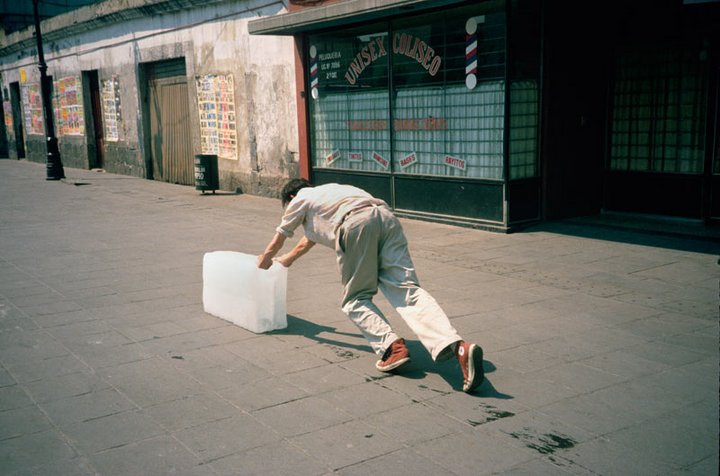
‘Paradox of Praxis’ comments on themes of futility and pointlessness inherent in social, cultural and economic structures. Alÿs is partly performing an absurd act for dramatic effect but he is also re-enacting ice deliveries which are common, everyday events in Mexico City. Ice deliveries are an overlooked part of daily reality which Alÿs observed and used to symbolize the disparity between social and economic realities in Mexico City. Alÿs positions himself as the main protagonist in the film but through him we also become aware of the city around him. The city is full of structures and people performing their daily routines and Alÿs performs his own routine. In doing so, he draws attention to the fabric of the urban area. The work acts as a record of the routines and structures of the city.
Alÿs originally trained as an architect in Belgium before relocating to Mexico City in 1986 and switched to working in the visual arts. He has described this decision as a series of chance encounters. His work also explores and embraces elements of chance and risk such as using unplanned walks as starting points for projects or as the subjects of projects themselves. These walks also explore urban tensions and geopolitics. In 2004, Alÿs poured a line of green paint along the 1948 ceasefire line in Jerusalem for his work; ‘The Green Line’. In his early works, Alÿs performed as the main protagonist but in later works he has worked with other people, children and animals to create simple disruptions in social systems. In 2001, Alÿs peacocked the ultimate peacocking event in the art calendar by sending an actual peacock to represent him at the Venice Biennale for his work titled; ‘The Ambassador’.
…
There are several leading contemporary artists who have gone to extremes to explore ideas in the creation of new artwork. Using extreme methods has led these artists to display obsessive and borderline mad behaviours. We’ll explore key works from leading contemporary artists which have pushed the boundaries of taste and art. Read more from the new series here.
Further reading:
https://francisalys.com/sometimes-making-something-leads-to-nothing/
https://publicdelivery.org/francis-alys-ice/
https://en.wikipedia.org/wiki/Francis_Al%C3%BFs
https://www.tate.org.uk/art/artworks/alys-ice-4-milk-t12198
https://www.tate.org.uk/tate-etc/issue-19-summer-2010/telling-stories-life-their-own
 contemporaryartprojects.art.blog