Inside the mind of #olafureliasson

In this new series of posts, we’ll explore the histories of key leading contemporary artists and the starting points of their creative practises.

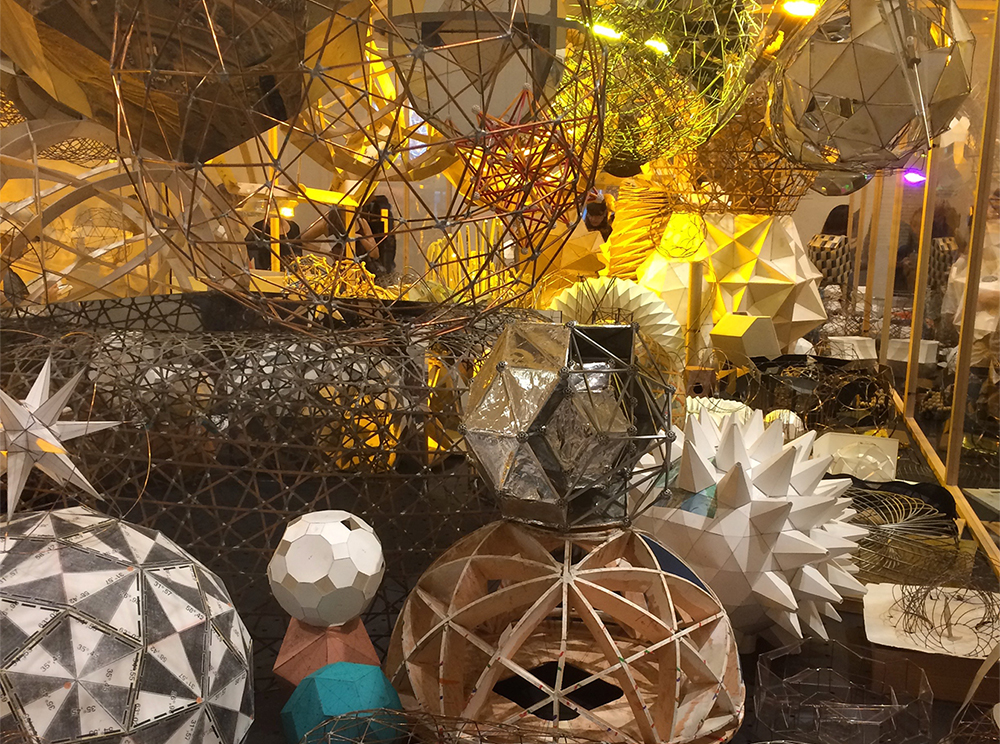
The Danish-Icelandic artist Olafur Eliasson creates large scale, immersive art installations. They take over spaces and hypnotize crowds of viewers. His work explores questions facing the world today including renewable energy, climate change and migration.

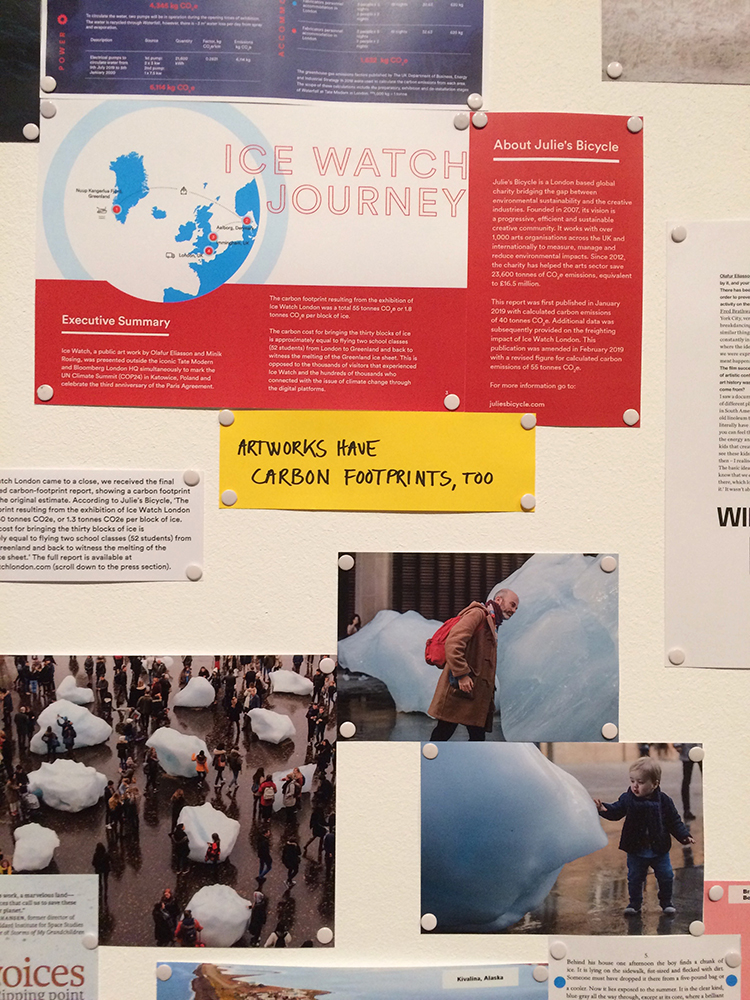
Eliasson’s work is informed by research and he utilises this on long pin-board walls where collaborators share questions, articles, images and news clippings. They expand from keywords and themes which guide collections of clippings like a giant brainstorm. An exciting energy is created by potential avenues of investigation created by the vast amount of information. The research stage is a hotbed of ideas and creativity which ultimately become artworks.

Inside the mind of #NamJunePaik

In this new series of posts, we’ll explore the histories of key leading contemporary artists and the starting points of their creative practises.

Artist Nam June Paik was a leading video artist and helped to bridge the gap between art and technology with his experimental work. Nam was born in Seoul, South Korea in 1932 but travelled extensively including to Japan, Germany and the USA. His work often reflects the traditions of the countries he lived in and draws attention to the connectedness of cultures. In 1974, Nam coined the phrase ‘Electronic Superhighway’ as a way of describing his video work and predicting a global information network.

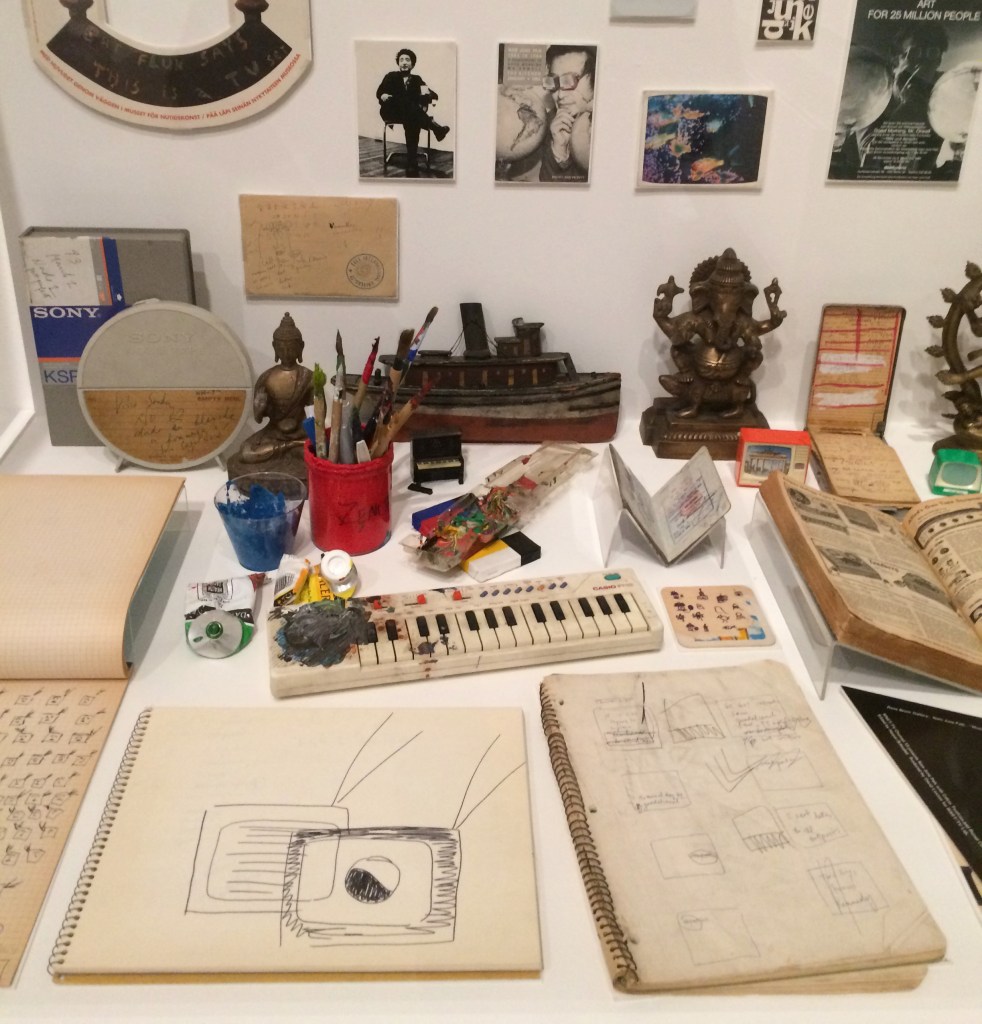
A display of sketch books and materials used by Nam June Paik

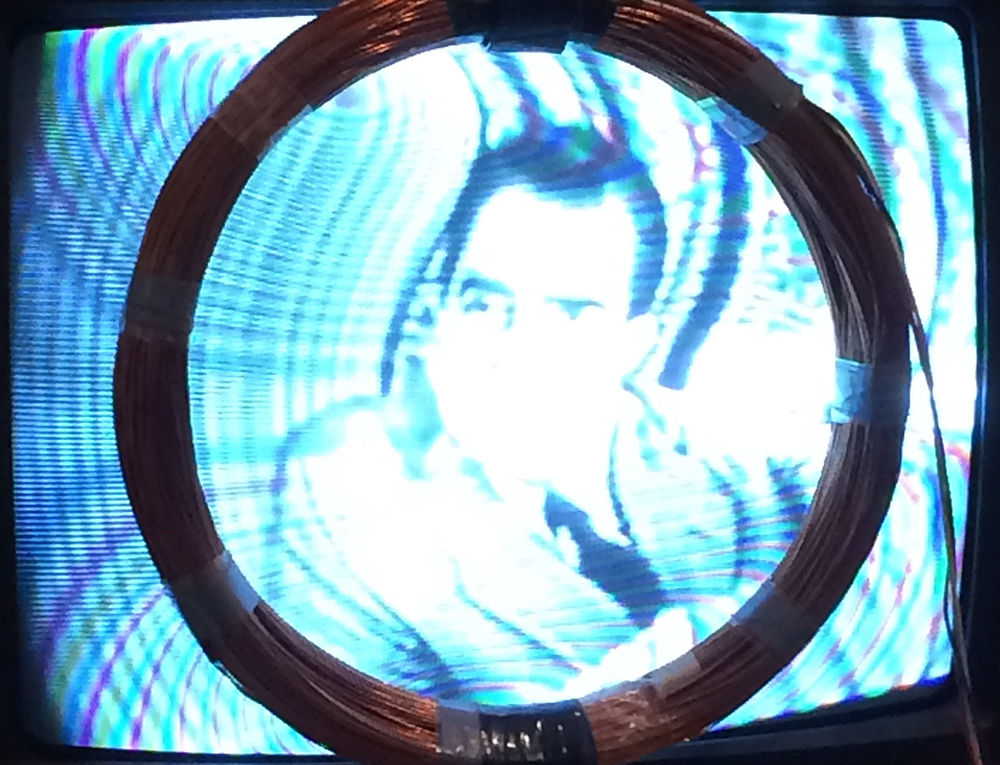
Nam’s work is influenced by the traditions and philosophies of the countries he visited. He collected objects from both Eastern and Western cultures. These were objects which he used for reference and they shed light on his broad interests. They include his address book, notebooks, Casio keyboard, toy TVs and robots. Nam started experimenting with TV’s and audio-visual equipment in the early 1960’s. He used magnets to distort their images as a way of subverting their manipulative power. Nam believed that artists could help make video a more democratic tool for social benefit.

Art Process: Pope. L

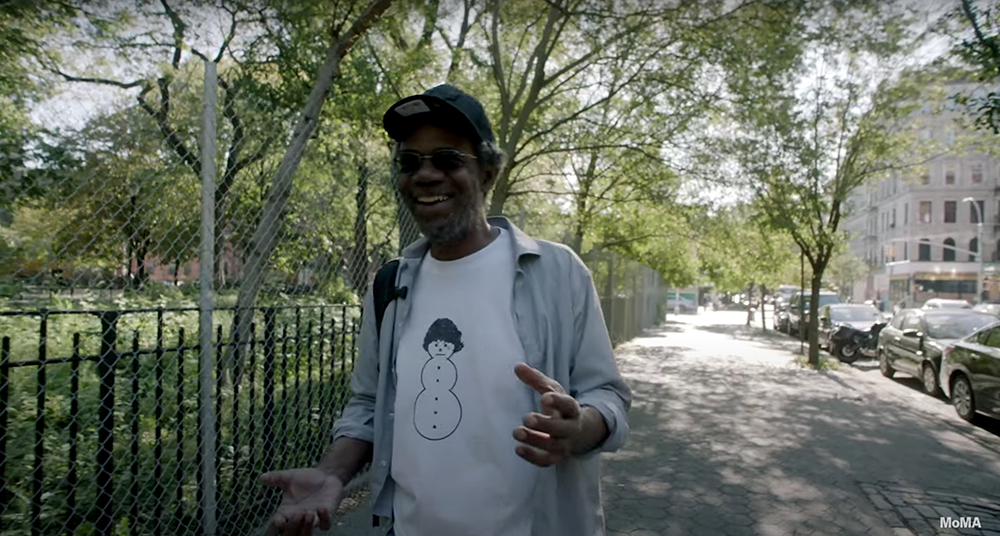
Pope.L, aka, William Pope.L, aka, the self-professed “friendliest black artist in America” guides us around the streets of the East Village in New York City. He’s revisiting the site of a past performance where he crawled on knees and elbows around the streets wearing a full suit while holding a potted flower. He did this to highlight the social inequality and divisions in the United States. As Pope.L says he was concerned with, “where are you in space. Who owns that space”. He talks about the process of crawling. Although this involved coming face to face with all kinds of organic nasties, Pope.L still recommends it as an activity, “It’s kind of uplifting. Crawling, if you’ve never tried it you should”.

The subject of Pope.L’s work confronts a serious social concern. It exists across the world and it’s ongoing. He addresses this problem of inequality in the urban environment as a human concern and he does it with great wit, humour and humanity. I get the feeling this is how he approaches life. Pope.L is very charming. He’s playful, inquisitive and funny. He’s got a nice little chuckle as he describes his work.

Pope.L looks like a normal guy. There’s no pretention. He’s casual but his glasses give him a studious vibe. Don’t be fooled. He’s not playing. Archive pictures of his performance make him look absurd. A surrealist! Why would someone do that? The people on the streets look shocked. But what he did was completely pertinent. The physicality of his performance really highlighted the issues of inequality in the urban environment as a human concern. The power of the work was to take the subject out of academia, out of the note pads of law makers and journalists and place it back in the physical world.

Film credit: Moma

Art Process: Jonathan Meese

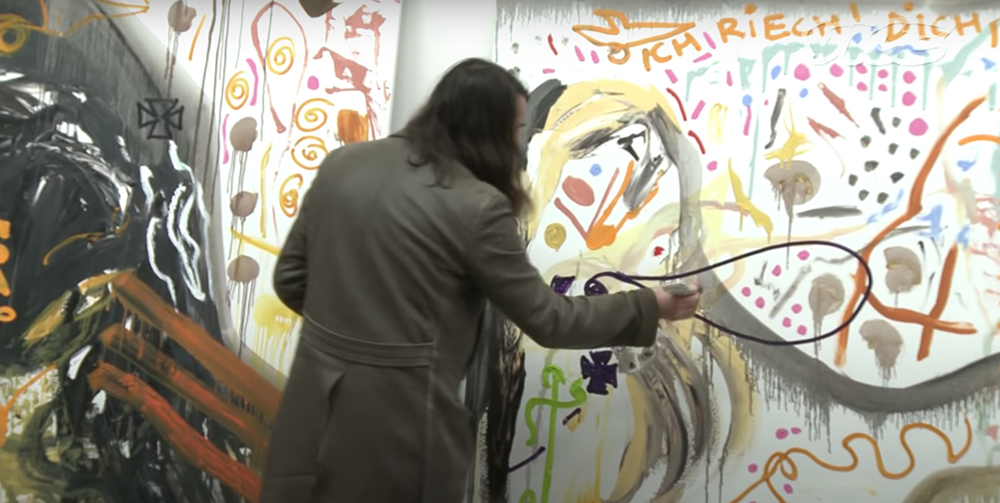
Meese has a crazy, intense energy. He’s holding a tube of paint which he uses to paint directly onto the surfaces around the studio. He does it so casually, quickly drawing a cross here, a swastika there and then a few random dashes, dots or lines. It looks like he doesn’t care about what he’s doing but he talks so intensely and deliberately that we know he must either be nuts or purposeful about his practise. Symbols are repeated in his work over and over again. They are mixed up with the squiggly lines, splashes, drips, words and collaged bits in the pictures. The symbols become redundant of meaning. Meese is performing. He plays around with a plastic sword while wearing a fake soldiers helmet. But so are his works. He tells us that; “everything is a toy. Even humans are toys for art and we must play with all the material we can find…”. It’s a chaotic world where nothing has meaning. Only the visual has meaning in itself and chaos is the future. Chaos is the way out of corruption. The only thing that is certain in Meese’s world is that Scarlett Johansson is “totally art”!

Film credit: Vice

Extreme Methods: Francis Alÿs

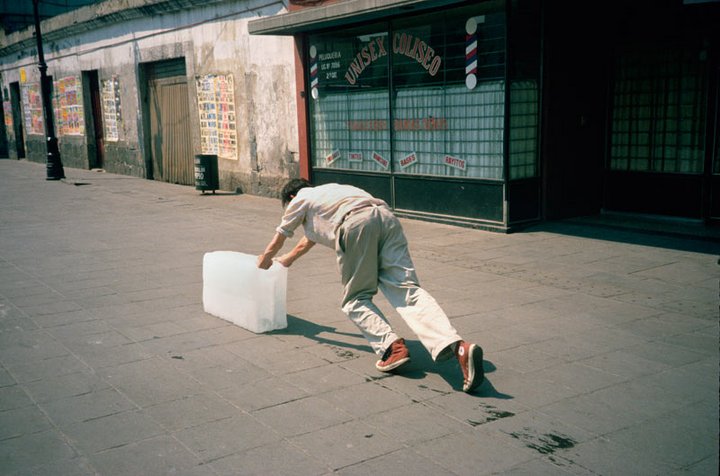
Pushing a large block of ice around a city until it melts may seem like a punishment from Greek mythology but this is exactly what artist Francis Alÿs did for his work ‘Paradox of Praxis 1 (Sometimes making something leads to nothing)” from 1997.

We start this epic journey by following Alÿs as he pushes a large block of ice down a street in Mexico City. The drips and drabs of melted ice water start to accumulate into small puddles on the grey slabbed city pavement. Alÿs is wearing a pair of red Converse high-top trainers as he slides the block along. He is hunched over and his sleeves are rolled up as he puts his back into the task at hand. We follow his journey through the city and we become aware of the buildings, the cars, the shops, the noises and the other passer’s bye but no one seems to notice him as he pushes a child sized block of ice down the street. The film continues and we are presented with several different view-points of the ice block and Alÿs himself as the journey progresses. As the ice block starts to shrink it becomes possible for Alÿs to start casually kicking it along while he smokes a cigarette. His body gestures have become more casual and it seems less of an act of serious labour and more of experimentation or intervention. After nine hours of pushing, kicking, lifting and sliding the block through the streets of Mexico City it melts to the size of an ice cube and ends its life as a small puddle on the pavement. The film ends with three young boys standing by the puddle and smiling up at the camera.

Paradox of Praxis I (Sometimes Making Something Leads to Nothing), Mexico City, 1997 © Francis Alÿs

‘Paradox of Praxis’ comments on themes of futility and pointlessness inherent in social, cultural and economic structures. Alÿs is partly performing an absurd act for dramatic effect but he is also re-enacting ice deliveries which are common, everyday events in Mexico City. Ice deliveries are an overlooked part of daily reality which Alÿs observed and used to symbolize the disparity between social and economic realities in Mexico City. Alÿs positions himself as the main protagonist in the film but through him we also become aware of the city around him. The city is full of structures and people performing their daily routines and Alÿs performs his own routine. In doing so, he draws attention to the fabric of the urban area. The work acts as a record of the routines and structures of the city.

Alÿs originally trained as an architect in Belgium before relocating to Mexico City in 1986 and switched to working in the visual arts. He has described this decision as a series of chance encounters. His work also explores and embraces elements of chance and risk such as using unplanned walks as starting points for projects or as the subjects of projects themselves. These walks also explore urban tensions and geopolitics. In 2004, Alÿs poured a line of green paint along the 1948 ceasefire line in Jerusalem for his work; ‘The Green Line’. In his early works, Alÿs performed as the main protagonist but in later works he has worked with other people, children and animals to create simple disruptions in social systems. In 2001, Alÿs peacocked the ultimate peacocking event in the art calendar by sending an actual peacock to represent him at the Venice Biennale for his work titled; ‘The Ambassador’.

There are several leading contemporary artists who have gone to extremes to explore ideas in the creation of new artwork. Using extreme methods has led these artists to display obsessive and borderline mad behaviours. We’ll explore key works from leading contemporary artists which have pushed the boundaries of taste and art. Read more from the new series here.

Further reading:

https://francisalys.com/sometimes-making-something-leads-to-nothing/

https://publicdelivery.org/francis-alys-ice/

https://en.wikipedia.org/wiki/Francis_Al%C3%BFs

https://www.tate.org.uk/art/artworks/alys-ice-4-milk-t12198

https://www.tate.org.uk/tate-etc/issue-19-summer-2010/telling-stories-life-their-own

https://www.youtube.com/watch?v=XlbMXLQWvfg

Extreme Methods: Bas Jan Ader

There are several leading contemporary artists who have gone to extremes to explore ideas in the creation of new artwork. Using extreme methods has led these artists to display obsessive and borderline mad behaviours. In this new series, we’ll explore key works from leading contemporary artists which have pushed the boundaries of taste and art.

Bas Jan Ader was a Dutch conceptual artist who created film and photography to document his performances and actions. He was a prankster, a risk taker and a showman but his work also has a poignant message to tell. As the main protagonist, Ader leads us into the work and on an adventure into the unknown.

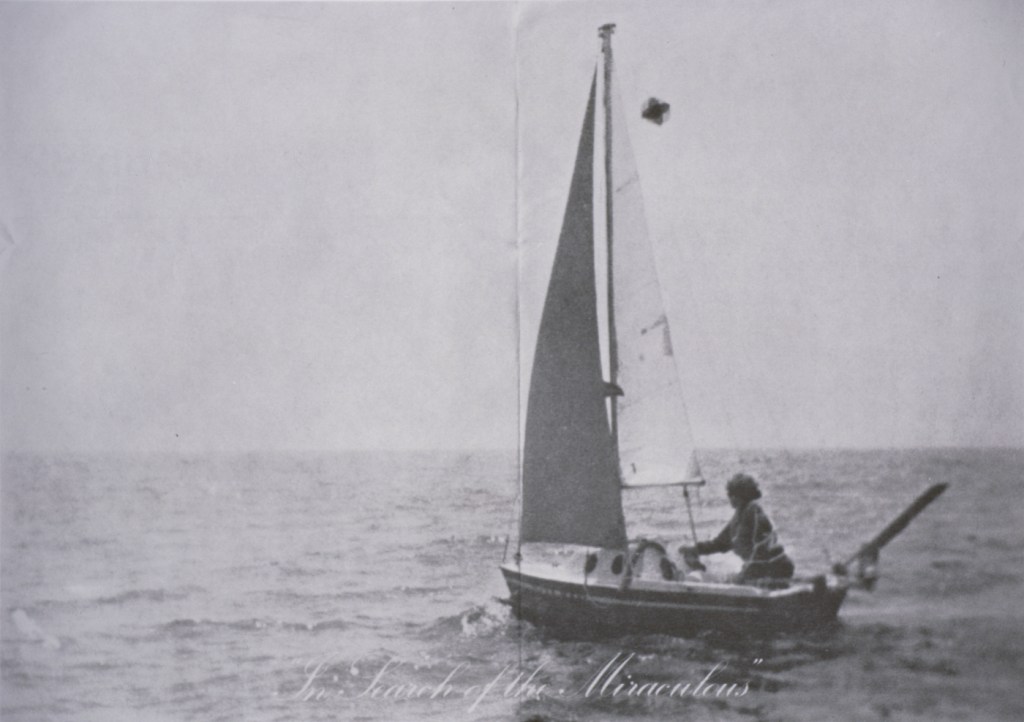
In 1975, Ader set out on a journey as part of a trilogy of events which made up the ‘In Search of the Miraculous’ project. The journey formed the second act of the trilogy and involved a solo attempt to sail across the Atlantic Ocean in a sail boat named the ‘Ocean Wave’. Ader planned to cross the Atlantic to reach England and then onwards to the Netherlands to an exhibition of his work in the Groniger Museum. The show had been planned to present a display of film and photography to compliment work shown in an earlier exhibition at the Claire Copley Gallery in Los Angeles. The two exhibitions and journey were conceived as a collective work and a way of connecting the theme of exploration and the geographic locations together.

Bas Jan Ader, Bulletin 89, published by Art & Project, Amsterdam (August 1975),photo lithography on paper, 11 5/8 x 16 9/16 inches (unfolded) (© Estate of Bas Jan Ader / Mary Sue Ader Andersen, 2016 / The Artist Rights Society (ARS) New York, courtesy Meliksetian | Briggs, Los Angeles)

Ader’s work explores themes of failure, absence and identity. His films and photographs document enigmatic performances and actions where Ader placed himself in situations with controlled risks. These short films often start and end abruptly. The results are pure slapstick but also tragic. In his ‘Fall series’ of short films, Ader can be seen placed in precarious situations including sitting on a chair on top of a steep sided roof, cycling a bicycle very close to a water canal or clinging to an unstable tree branch above a river. The outcomes, as the titles suggest, show Ader falling in pure slapstick comedy style. This is Jackass before there was Jackass. But there is also a sense of tragedy and when viewed on a loop the comical effect wains and we are left with a sad sense of inevitability.

After Ader set sail from Massachusetts in 1975 he was never seen again. Ader’s boat was found ten month later off the coast of Ireland containing only old food and various identification documents. Ader was listed as missing but later pronounced dead without the recovery of his body. The surviving photo of Ader leaving in the Ocean Wave was taken by his wife Mary Sue Ader Andersen.

Ader placed himself in jeopardy for his art and put the audience in the role of witness to the risks he had taken on. This shared experience creates a lived, emotional connection between the artist and the audience. It may be that in his search for a connection with the audience that Ader finally placed himself in a position of risk that he could not control. As Rene Daalder recalls; “He wanted to make a masterpiece, desperately” * even if it cost him his life. ‘In Search of the Miraculous’ and Ader’s death have become things of contemporary art folklore. Many conspiracy theories exist about Ader’s speculated survival and how he may have faked his death. Maybe he is still out there continuing the search for the miraculous.

Read more from the blog here.

*Rene Daalder, ‘Here is Always Somewhere Else, 2007, Agitpop Media

Further reading;

https://hyperallergic.com/336146/in-search-of-bas-jan-ader-the-artist-who-disappeared-at-sea/

http://www.basjanader.com/

https://en.wikipedia.org/wiki/Bas_Jan_Ader

https://www.moma.org/artists/32766

https://www.simonleegallery.com/exhibitions/46/

https://www.youtube.com/watch?v=W0mpVdt5aa0&t=2949s

Contemporary Art Classics: ‘Mogamma, A Painting in Four Parts: Part 3’

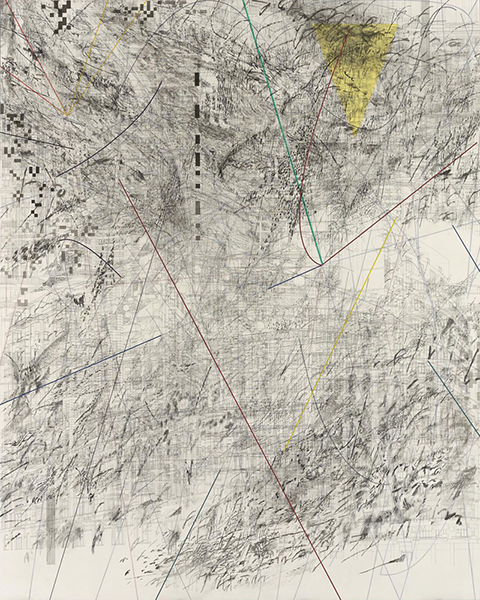
A collection of grids, lines, marks and shapes swirl around the picture surface in Mogamma: Part 3. The marks have been drawn or painted in ink and acrylic paint on canvas. There is no central point to the painting, but we can make out various architectural forms between the torrents of marks. The sweeping clusters of lines and shapes push and pull our view across the picture plane. Standing in front of this huge painting is like experiencing the force of a hurricane. Morgamma: Part 3 is part of a series of four paintings made by artist Julie Mehretu. They were first exhibited at Documenta art fair in 2012. The painting is titled after Mogamma, an Egyptian government building in Tahrir Square in Cairo, which was both a symbol of bureaucracy and centrally located during protests in 2011. Tracings of Mogamma and other historic sites such as Meskel Square in Addis Ababa and Zuccottu Park in New York have been depicted in the series of paintings. The buildings have been overdrawn with instinctive mark making and obscured in such a way that they have lost their symbolic power. The result is that sites of bureaucratic power and communal resistance have both been reduced to two dimensions and swept up in a chaotic frenzy of expression. Perhaps this painting represents a new order emerging?

The work is part of the Tate Collection.

Read more Contemporary Art Classics here.

Interview with artist Florence Hutchings for @floorrmagazine

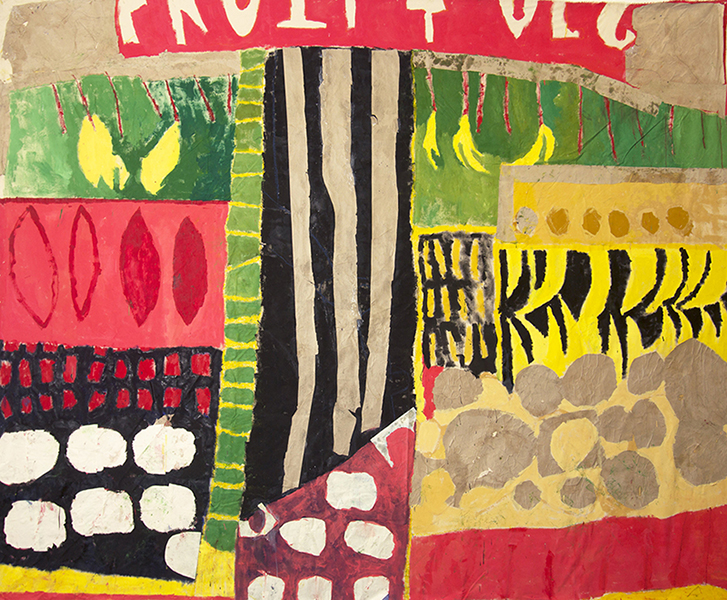
“The dialogue with the work and the space around it continually changes. Whether it be the work in the studio having a messier feel or being placed in an interior type gallery it could hold a homely relatable feel or if it is placed in a traditional white cube space it gives it a ‘finished’ feeling. There is definitely a connection with the ideas of still life and merging that with abstraction. Pushing the painting in ways to create ambiguity is something I enjoy. I like when the viewer is not necessarily sure what they are looking at. People have mistaken jackets for mermaids tails, ladders for rollercoasters and chairs for sinks.”

Read the full interview with artist Florence Hutchings here;.

https://www.floorrmagazine.com/issue-19/florence-hutchings

Image credit: ‘Fruit and Veg Market, 2017’  © Florence Hutchings

Read more interviews here; https://contemporaryartprojects.art.blog/category/interviews/

Contemporary Art Classics: ‘My Bed’

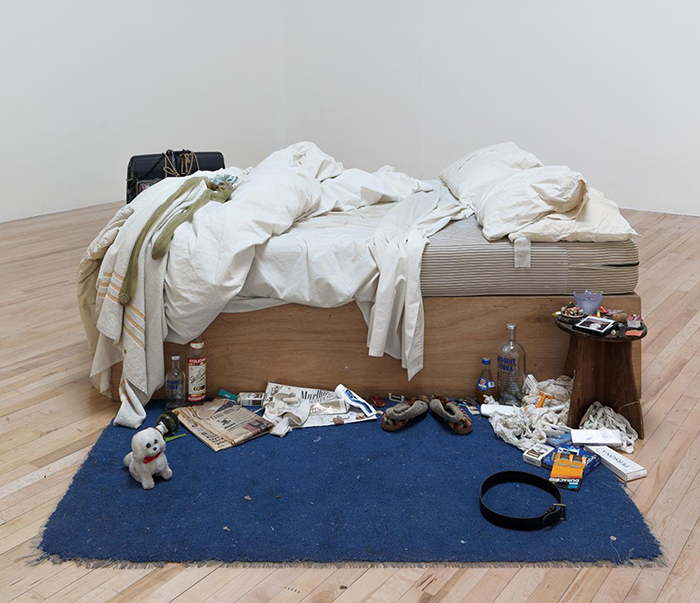
‘My Bed’ is an iconic work of art. It is an artwork which splits opinions and provokes strong reactions. Tracey Emin first created ‘My Bed’ in 1998 and included the piece in an exhibition shown at the Tate gallery in 1999. The show was shortlisted for the Turner Prize for contemporary art in the same year. ‘My Bed’ is an installation made up of the artists own bed in a state of disrepair. It recreates and represents a turbulent phase in the artists life. The artwork is highly personal and contains various intimate items. Stained bedsheets, used condoms and underwear are some of the items which shocked the media and brought the artwork to the public’s attention. The artwork is brutally honest, confessional and unashamedly open. It is a self-portrait of the artist through her absence. The arrangement of the bed and objects recreate part of the environment which housed the artist and reflect a moment when she was suffering from depression and relationship problems. Tracey Emin is one the YBA’s (Young British Artists) whose work became prominent in the 1980’s and well known for its provocative style and content.

The work is part of the Tate Collection.

Read more Contemporary Art Classics here.

Kitchen Sink Painting

The Kitchen Sink Painters were a group of British artists who made artwork depicting scenes of everyday life. The term ‘Kitchen Sink Painting’ was invented by art critic David Sylvester as a way to deride their work which he critically characterised as; “An inventory which includes every kind of food and drink, every utensil and implement, the usual plain furniture and even the babies’ nappies on the line. Everything but the kitchen sink – the kitchen sink too.”

But what’s wrong with painting the kitchen sink? Artworks based on direct observation are a useful insight into what an artist is seeing, thinking and feeling at the time. They might also tell us about the intimate details of an artist’s life and act as a valuable record of the social and political context.

‘Still Life with Chip Frier’, 1954 by artist John Bratby is a great example of ‘Kitchen Sink Painting’. It is a celebration of object and form in paint. The painting was made with oil paint on hardwood. The work depicts what looks like most of the contents of the artists kitchen laid out on a dark brown table. It’s an epic still life which buzzes with a light-hearted energy. Importantly it offers a glimpse into the artists reality.

‘Still Life with Chip Frier’, 1954 by ©John Bratby

‘Still Life with Chip Frier’, 1954 by ©John Bratby

Art exploring domesticity has a long-standing tradition in art history. Whether it’s a picture of the bedroom of an aspiring modern artist or an artist’s view of their own feet while being in the bathtub, artists have taken inspiration from their domestic surroundings.

The subject of domesticity continues to be an important theme in contemporary art. Here I’m going to look at a few key examples of contemporary artworks which explore domesticity in different ways.

'Seizure' © Roger Hiorns

‘Seizure’ © Roger Hiorns

‘Seizure’ by artist Roger Hiorns was originally commissioned by Artangel in 2008. The artwork transformed an empty council flat in Southwark, London into a cave of beautiful, blue copper sulphate crystals. 75,000 litres of liquid copper sulphate were used to cover the entire flat in crystals. Domesticity was transformed into a sparkling fantasy. The work is now housed in Yorkshire Sculpture Park.

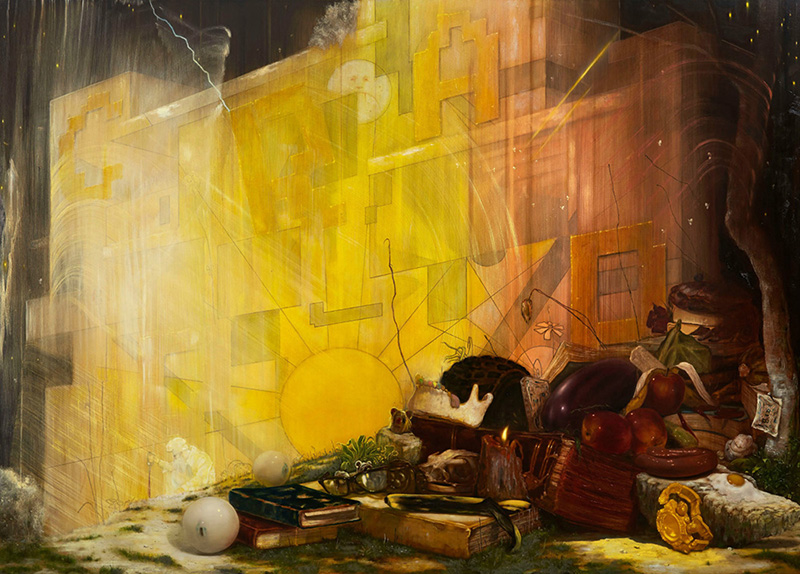
'Hubris' 2012-13, oil on linen backed with sailcloth 320 x 230cm © Nigel Cooke

‘Hubris’ 2012-13, oil on linen backed with sailcloth 320 x 230cm © Nigel Cooke

The painter Nigel Cooke plays with the conventions and traditions of still life painting in his work titled, ‘Hubris’ from 2012-2013. The painting depicts a group of objects piled up on a hill which are overlooked by a bright yellow, geometric modernist building. The objects are specifically selected to mimic and parody the conventions of still life painting. The prosthetic eyeballs, glasses, books, fine fruits, golden watch and fried egg are grouped together to represent a loss of creative confidence. This could mean the artists own struggle with creativity or with the conventions of painting and art itself. A faint figure in the distance can be seen poring out paint in the distance.

'After Lunch' 1975 acrylic paint on canvas © Patrick Caulfield

‘After Lunch’ 1975 acrylic paint on canvas © Patrick Caulfield

‘After Lunch’ by Patrick Caulfield combines different styles of representation to create a new picture. The painting depicts the inside of a restaurant in a bold, graphic style. The image is stylised and even a waiter is reduced to a few bold outlines as he overlooks the inside of the venue. Most of the scene is created with straight black lines on a flat blue background except for one section within the picture. This rectangular section depicts a landscape scene in a photo realistic style. The contrast of styles creates a tension. Our gaze is drawn to the landscape section even though we know it is no more ‘real’ than the rest of the picture. This play between interior and exterior creates an ambiguity which leaves us questioning the depiction of reality in the picture.

Find out more; https://www.tate.org.uk/art/art-terms/k/kitchen-sink-painters

Read more blog posts; https://contemporaryartprojects.art.blog/blog/
Design a site like this with WordPress.com
Get started