“Shock value for its own sake isn’t interesting, if it’s even possible to conjure it post-Information Age. However, I do look to inject a certain level of visual immediacy within the work to engage the viewer in a dialogue around the nature of imaging making. This links back to the idea of the primal or carnal. Food, sex, and death are staple subjects within art history but are also categorised as our most primitive drives. In contrast, art itself is often viewed as almost synonymous with developed civilisation, as the antithesis of our primal nature. This separation of human behaviour strikes me as an illusion, so an uneasy relationship between art and nature runs through the work. I set out to use the language of image-making iconoclastically; to deconstruct itself.
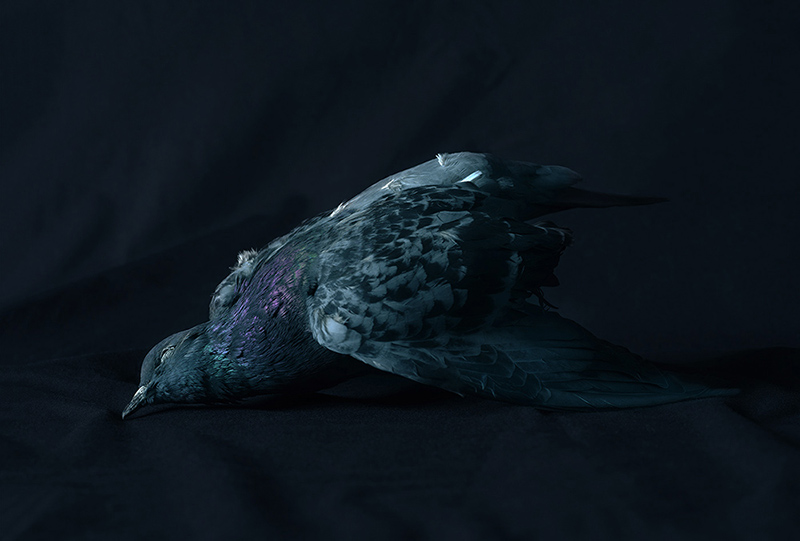
The images hopefully work to seduce the viewer with what they may normally find objectionable; blurring the line between observation and voyeurism. Dead animals, morally ambiguous scenes of sex and gluttony; they are looking to trigger a morbid curiosity and a tension between desires and internalised ideals. This is where the environment, lighting, and installation of the work comes into play. The lighting, both within the image, and of the image itself (they are often spot lit in dark rooms), directs the viewer where to look, encouraging a peep-show-like spectacle of voyeurism.
The triggering of uncanniness within the work is used to shed some light on the illusory nature of our relationship with imagery. I’m drawn to digital mediums because they lend themselves well to dealing with ideas around illusion, artifice, and the re-presentation of nature within art; they serve as tools within the work to address our vulnerability to the power of images.”
Check out the work of Theo Ellison in an interview I did for Floor Magazine. Theo creates images which are simultaneously unsettling and alluring. Find out more by reading the full interview here;
https://www.floorrmagazine.com/issue-16/theo-ellison
Top image: After Zuburan ©Theo Ellison
Read more artist interviews here; https://contemporaryartprojects.art.blog/category/interviews/
 contemporaryartprojects.art.blog